New Strain Alert: Ultra Tangie
Audio unavailable right now. Please read on below.
Key takeaways
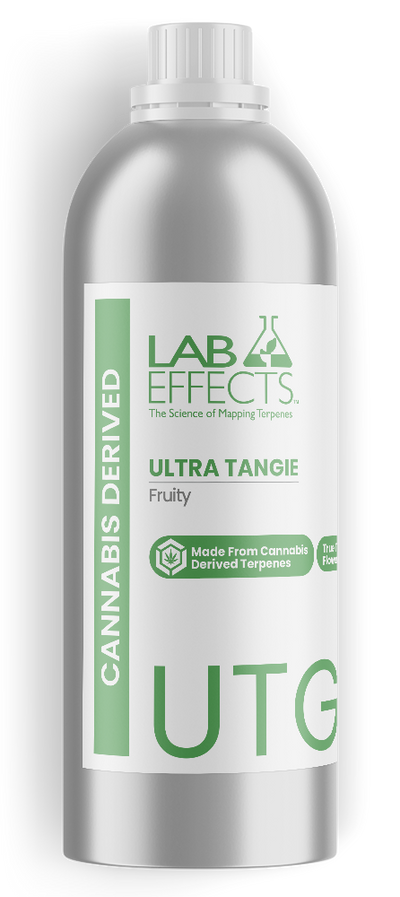
Ultra Tangie is in the catalog now, in all three lines, from 2ml samples up to liters.
The nose is tangerine, the way fresh peel smells when you break it with a thumbnail rather than the way orange candy smells. Underneath that there is a light berry sweetness and a floral note sitting behind the citrus, and that floral piece is what keeps the top from going sharp. Sativa leaning, uplifting, and it lands where you would expect it to land, which is daytime product.
Here is where the name comes from, because the Tangie line has real history behind it.
The line

Tangie belongs to Crockett Family Farms. Crockett bred it, DNA Genetics carried it to the wider market, and that distinction gets flattened constantly in strain writeups. DNA's own listing gives the background as clone only crossed with Crockett's selection, which is DNA crediting the selection work rather than claiming the breeding.
The cross is California Orange to a Skunk. Beyond that there is a genuine discrepancy worth stating instead of smoothing over. DNA's copy names Skunk Number One specifically. Crockett's own page says only Cali Orange crossed with Skunk. The Skunk side is otherwise given as a Skunk hybrid whose second parent nobody names. So California Orange to a Skunk is solid. California Orange to Skunk Number One specifically is one house's claim, and every writeup that repeats it as settled is repeating marketing copy.
Crockett puts the lineage back to the mid nineties, and he uses selection language throughout, which leaves open whether he made the original cross or pulled a keeper out of somebody else's work. Nobody has published who made that first cross, and inventing a name to fill that gap does not help anyone.

The line kept going. Crockett's Sour Tangie, Kosher Tangie, Double Tangie Banana, Tangieland, Tangielope, Jack Tangie. One profile turning into a family is how you know it's been hype.
Further back
California Orange is seventies California. Dutch Passion's founder Henk van Dalen brought seeds back to Amsterdam from a Cali road trip in that decade and it became one of the early foundation lines over there. Dutch Passion preserved and popularized it, and no original breeder is named anywhere. Royal Queen Seeds dates it to the eighties instead, so even the decade has two versions, and van Dalen's is the firsthand one.
Dutch Passion describes it as a sweet penetrating citrus aroma with a zesty mandarin taste and what they call old school Cali dankness. Read that against the Ultra Tangie profile and the inheritance is sitting right there in the top notes.
Skunk Number One is messier, and anyone who tells you it is simple is picking a side. What is established: it came out of Sacred Seeds, a Bay Area breeders collective that published a twenty eight strain catalog in 1981 and was raided by police in 1982, after which David Watson, known as Sam the Skunkman, carried the genetics to the Netherlands. Who actually made it is contested three ways. A 1969 cross of Colombian Gold to an Afghan male by a person known only as Jingles. Sacred Seeds working it as a group of roughly six breeders, Mendocino Joe and Maple Leaf Wilson among them. Or Watson's own version, in which he stabilized it alone. Those do not reconcile, and the honest version of Tangie's pedigree includes that unresolved half.
The trophy case
Tangie's competition record is worth talking.
First place, High Times Cannabis Cup 2014, sativa, Crockett Family Farms. Second place in the same category that year, DNA Genetics. First place, High Times Cannabis Cup 2013, sativa, Reserva Privada. Third place in 2013, Bushdoctor. Second place, Spannabis Cannabis Champions Cup 2015, bio category, DNA Genetics. Sixth at the Karma Cup 2017, hybrid. Ninth at the Karma Cup 2018, sativa.
Crockett says it won over twenty awards in two years. Seven are itemized publicly and the rest is his claim rather than a list anybody can check.
Worth clearing up, because the names collide. Barney's Farm Tangerine Dream is unrelated to any of this. G13 crossed to a G13 and Neville's Haze cross, first at the 2010 Cannabis Cup, sharing nothing with Tangie but a citrus word.
How the profile behaves

Citrus is the least forgiving thing in a vape formulation. The tangerine and orange peel end of an aroma sits in the lightest, most volatile fraction, so it goes first in heat, and that is why a citrus cart can taste bright on the first pull of the day and flat by the tenth. The citrus reads hardest on the opening and the sweeter, floral parts carry the finish. A cart that smells like fresh peel out of the box and tastes like sugar water by the end of the tank is usually a heat problem rather than a blend problem. Ceramic coils hold the profile. Cotton works and plenty of hardware still ships with it, but cotton picks up a burnt taste much sooner, and on a citrus forward blend you notice that sooner still.
Inclusion is where this profile rewards restraint. Push a bright citrus past where it wants to sit and it goes from tangerine to cleaning product, because the same volatility that makes it read so clearly at the right rate makes it harsh above it. Our starting points are 7 percent in a vape, 1.5 in a tincture, 1 in a gummy and 0.5 in a topical. On the citrus side of the catalog, the vape number is a ceiling more often than a floor.
In a wash

Ultra Tangie is not a washer. That is not a knock on the plant.
Water hash depends on the resin head letting go of the stalk cleanly, a structural trait with nothing to do with how good something smells. Sandy beats greasy. Touch the plant, and if your gloves come away instantly slick because the heads are bursting instead of snapping off, that cultivar is not giving you hash without solvents no matter how loud the nose is. Durban Poison is the example everybody knows, and it is a great plant.
Breeders are working flavor and structure and wash performance all at once, and terps are table stakes for every one of them. Some plants just do not hand their resin to cold water.
Which leaves hydrocarbon or dry sift as the efficient routes for this one.
Hydrocarbon means butane and propane in a closed loop, run cold. Propane boils at about 44 below zero Fahrenheit and butane at about 31, and terpenes do not start moving until somewhere around 70 to 100 degrees, so the solvent comes off underneath the aromatics rather than through them. That gap is why closed loop hydrocarbon keeps aroma as well as it does, and why live resin tastes like the plant it came from. Dry sift keeps the profile too, with its own conversation about yield.
So a plant like this one reaches a concentrate with its nose intact. The profile goes missing further downstream. Purge is heat and vacuum applied on purpose, and the volatiles are the first thing it takes. Distillation removes the aromatic fraction outright, which is why distillate arrives odorless and why almost every cart on a shelf has its flavor added back after the fact.
That is what a blend is for. A profile like Ultra Tangie goes back into material that no longer carries one, at a volume and consistency no single harvest can supply. An argument about where the aroma went in the process, rather than one against anyone's hash.
Getting it
The 2ml sample exists so you can put it on a coil before you commit to a size.
All natural, never synthetic, and compliant across all fifty states.